47 Counties, 290 Constituencies, 1,450 Wards: How Kenya Fits Together
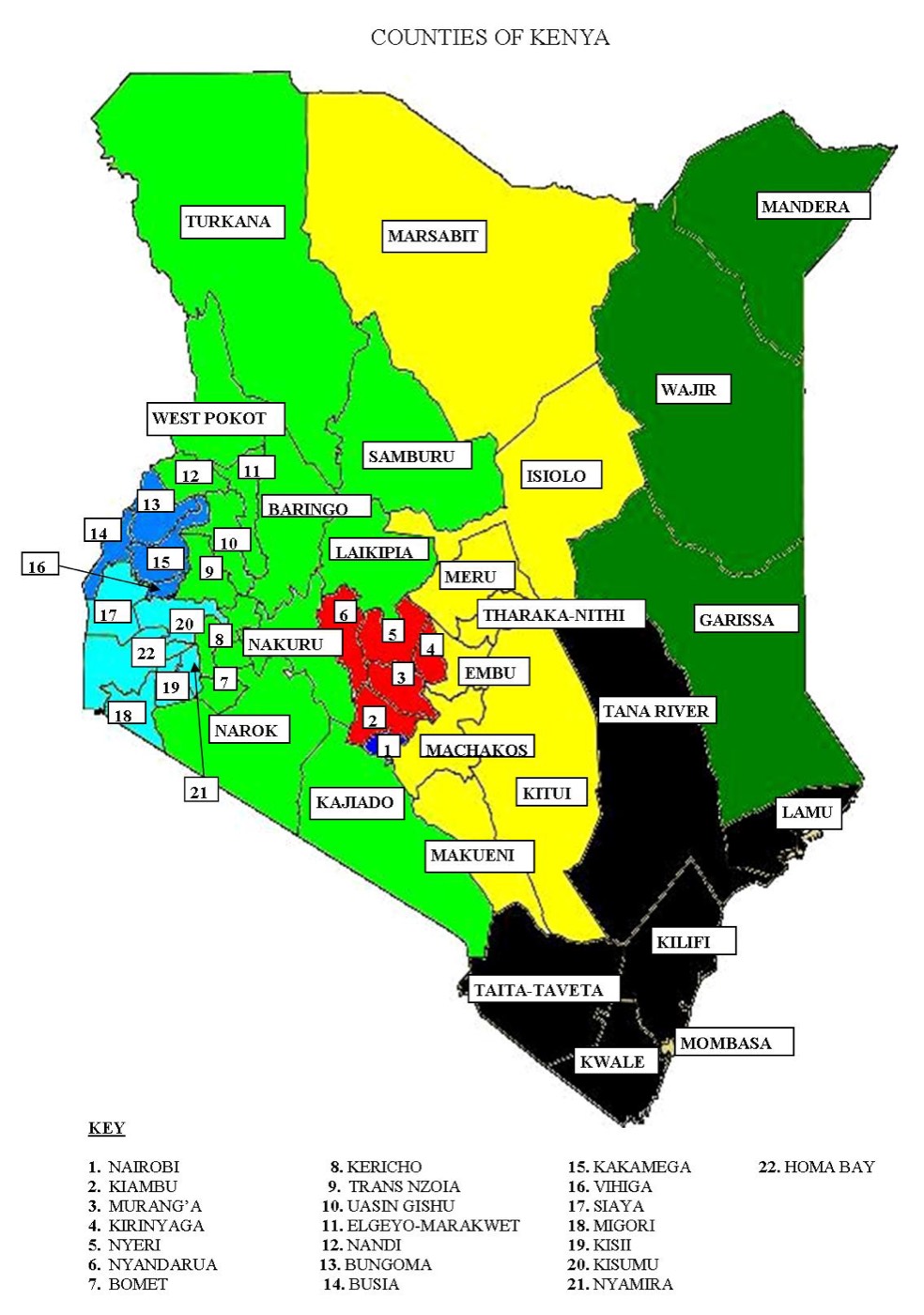
Kenya has 1,450 wards, spread across 290 constituencies and 47 counties, and each ward elects one member of its county assembly. The IEBC's register of voters for the 2022 general election lists every one of them, from 10 wards in Lamu to 85 in Nairobi City. The map stays put for 2027: Capital FM reported on 27 January 2026 that the commission had postponed its boundary review until after the 2027 general election.
Those three numbers are the skeleton of every election, every campaign budget and every results night in the country.
They nest. A ward sits inside a constituency. A constituency sits inside a county. Nothing crosses a line above it, which is why a results total can be built upwards from the smallest unit without anything being counted twice.
How many wards each county has
We counted the figures below from the IEBC's list of registered voters per county assembly ward for the 2022 election, the latest ward-level list the commission has published, and the 47 rows add up to the 290 constituencies and 1,450 wards in the commission's own total. Each county has exactly five times as many wards as constituencies.
A single constituency is less tidy. Most have five wards, but they run from three to eight.
| County | Constituencies | Wards |
|---|---|---|
| Mombasa | 6 | 30 |
| Kwale | 4 | 20 |
| Kilifi | 7 | 35 |
| Tana River | 3 | 15 |
| Lamu | 2 | 10 |
| Taita Taveta | 4 | 20 |
| Garissa | 6 | 30 |
| Wajir | 6 | 30 |
| Mandera | 6 | 30 |
| Marsabit | 4 | 20 |
| Isiolo | 2 | 10 |
| Meru | 9 | 45 |
| Tharaka-Nithi | 3 | 15 |
| Embu | 4 | 20 |
| Kitui | 8 | 40 |
| Machakos | 8 | 40 |
| Makueni | 6 | 30 |
| Nyandarua | 5 | 25 |
| Nyeri | 6 | 30 |
| Kirinyaga | 4 | 20 |
| Murang'a | 7 | 35 |
| Kiambu | 12 | 60 |
| Turkana | 6 | 30 |
| West Pokot | 4 | 20 |
| Samburu | 3 | 15 |
| Trans Nzoia | 5 | 25 |
| Uasin Gishu | 6 | 30 |
| Elgeyo-Marakwet | 4 | 20 |
| Nandi | 6 | 30 |
| Baringo | 6 | 30 |
| Laikipia | 3 | 15 |
| Nakuru | 11 | 55 |
| Narok | 6 | 30 |
| Kajiado | 5 | 25 |
| Kericho | 6 | 30 |
| Bomet | 5 | 25 |
| Kakamega | 12 | 60 |
| Vihiga | 5 | 25 |
| Bungoma | 9 | 45 |
| Busia | 7 | 35 |
| Siaya | 6 | 30 |
| Kisumu | 7 | 35 |
| Homa Bay | 8 | 40 |
| Migori | 8 | 40 |
| Kisii | 9 | 45 |
| Nyamira | 4 | 20 |
| Nairobi City | 17 | 85 |
| Total | 290 | 1,450 |
Under Article 89(4) of the Constitution, boundaries finished within twelve months of a general election do not take effect for it. A petition asking the High Court to order a review before the 2027 vote was still before the court on 22 September 2026, the Eastleigh Voice reported.
What each level actually elects
Each county elects one Governor, one Senator and one Woman Representative. Each constituency elects one MP. Each ward elects one MCA. The presidency is national and sits above all of it.
Six offices, six ballot papers, three different geographies. A voter in a village casts a ward-sized vote, a constituency-sized vote, a county-sized vote and a national vote in the same ten minutes, at the same desk, from the same register entry.
The county is two things at once
This is where most confusion starts.
A county is an electoral unit, and it is also a government. It has an executive led by a Governor and a legislature, the county assembly, made up of MCAs. It raises some of its own revenue, receives an allocation from national revenue, runs devolved functions, and is audited.
So when people say a county election, they may mean the Governor's race, or they may mean the whole set of contests that happen inside that county's borders. Both usages are common. When it matters, say which one you mean.
The Senate exists to represent counties at national level, which is why the Senator's constituency is the entire county rather than any part of it. The Woman Representative is elected county-wide too and sits in the National Assembly.
The constituency is a parliamentary unit, not a government
A constituency has no assembly, no executive and no budget of its own in the way a county does. It has one elected representative in the National Assembly, and it has a returning officer during an election.
That returning officer matters more than the abstract description suggests. The constituency is the tallying level for most of the ballot: results are filled at the polling station and brought to the constituency tally centre, where the forms in each series are consolidated before anything moves upward.
The ward is where the county assembly seat lives
Every ward elects one MCA to the county assembly. That assembly passes county legislation, approves the county budget and can, in the right circumstances, remove a Governor.
Most Kenyans could not name a single thing their county assembly voted on last year. That is not apathy so much as a reporting gap, and it is the reason MCA races are decided on personal contact rather than on record. Related: what an MCA actually does.
Below the ward: centres and stations
The hierarchy does not stop at the ward. Inside every ward are polling centres, and inside every centre are one or more polling stations. That is the level campaigns actually operate at, because agents are appointed per station and every results form starts life at one.
A ward is the smallest unit with an elected representative. A polling station is the smallest unit with a number.
Why the three totals are worth memorising
Because almost every claim you will hear about a Kenyan campaign is really a claim about coverage, and coverage is measured against these totals.
A party that says it is national is making a statement about how many of the 47 it can field in. A campaign that claims a ground operation is claiming something about wards. An agent recruitment plan is a claim about stations, which is a much bigger number than any of these three and the only one that decides whether a result can be defended.
Work out which unit a claim is about before you evaluate it. Most arguments in Kenyan politics are two people comparing different denominators.
What to do with this
Find your own position in the hierarchy and write it down: county, constituency, ward, polling centre, polling station. Related: how to confirm each one.
If you are planning a campaign, build your first spreadsheet at the level you will eventually need rather than the level that is easy today. Rolling ward data up into a county total takes a minute. Splitting a county total back into wards is impossible, and that is the mistake that gets discovered in the last month before 10 August 2027.
Frequently Asked Questions
How many counties, constituencies and wards does Kenya have?
Kenya has 47 counties, 290 constituencies and 1,450 wards. Each county elects a Governor, a Senator and a Woman Representative, each constituency elects an MP, and each ward elects an MCA. Wards sit inside constituencies and constituencies sit inside counties, so results build upward without anything being counted twice.
What is the difference between a county and a constituency?
A county is both an electoral unit and a government, with an executive led by a Governor and a county assembly of MCAs. A constituency is a parliamentary unit only: it elects one MP to the National Assembly and serves as a tallying level during an election, but it has no assembly or executive of its own.
Will Kenya have new wards for the 2027 election?
No new wards are planned. Capital FM reported on 27 January 2026 that the IEBC had postponed its boundary review until after the 2027 general election, and Article 89(4) of the Constitution says boundaries completed within twelve months of a general election do not take effect for that election.