Polling Clerks, the Queue, and How a Kenyan Polling Station Is Staffed
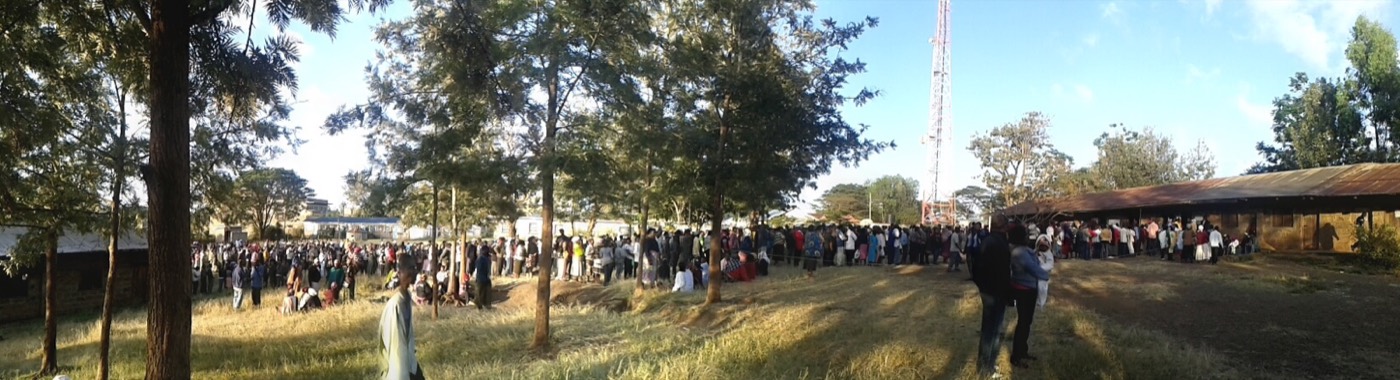
Six ballot papers have to reach the right hands in the right order, with nobody voting twice and nobody voting in the wrong stream. That is not a ceremony. It is a staffing problem, and the way it is solved decides how long you stand outside a classroom in the sun.
The roles inside one station
A presiding officer is in charge. Related: what that role covers.
A deputy presiding officer supports the presiding officer and takes over the station if the presiding officer cannot continue.
Polling clerks do the repetitive, high-volume work: identification, marking the register, issuing ballot papers, directing voters, and managing the queue.
A security officer is deployed to the station. Security officers are not IEBC staff. They are there to keep order, not to run the election, and they do not handle ballot papers.
Streams, and why a station is not always one room
A polling station is a place. A stream is a queue with its own register, its own ballot boxes, its own set of forms and its own officer.
The commission fixes a maximum number of voters per stream, and the figure is set in the regulations for each election rather than in the Constitution. When a station has more registered voters than that, it is split into multiple streams, and each stream produces its own complete set of A forms.
This is the single most misunderstood fact about Kenyan polling. A campaign that places one agent at a station with four streams has covered a quarter of it. Related: prove you have an agent for every stream.
What each clerk is actually doing
The identification clerk operates the kit. Your fingerprint or your ID number is checked against the register for that stream, and the kit confirms both that you belong there and that no ballot has already been issued to you. Related: what the kit does and does not do.
A clerk marks the register and applies indelible ink, which is the physical backstop against a second attempt.
Ballot paper clerks issue the papers. In practice the six ballots are handled in sequence, each stamped and folded, each accounted for against a counterfoil so the number issued can be reconciled at the close.
A clerk directs voters to the booth, and then to the correct box. Six papers and six boxes is where a queue slows down and where honest mistakes happen, and it is the reason the boxes are colour-coded and labelled.
A queue clerk works outside, keeping the line in order and pulling forward voters entitled to priority.
Who else is legally in the room
Candidate and party agents, accredited in advance. They are not staff, they cannot handle materials, and they cannot instruct a clerk. They can watch everything, note everything, and receive copies of the forms.
Accredited observers, domestic and international, under the commission's facilitation of observation.
Accredited media, under conditions the commission sets, which normally exclude filming a voter marking a ballot.
Nobody else. Not a candidate's campaign manager without accreditation, not a local official, not a person with a phone who wants a photograph of the count.
Why this shapes your day as a voter
Queue length is a function of streams, clerks and kits, and none of those are decided on the morning. They are decided months earlier when the returning officer publishes the stations and their streams. Related: who makes that decision.
A ward whose population has grown since the last general election and whose station allocation has not is a ward with long queues, and the time to raise that is while the allocation is still being made rather than on 10 August 2027.
What to do in 2026
Find out which polling station you are assigned to and how many streams it ran at the last general election. Both are matters of public record at your constituency office.
If you are organising, build your agent list by stream, not by station. A list that says "Mwiki Primary" is not a list. A list that says "Mwiki Primary, Stream 3" is.
And if you are simply voting, go early, carry your original ID, and expect six papers. Knowing that before you reach the front of the queue is worth more than any advice anyone will give you on the day.
Frequently Asked Questions
What is a polling stream in Kenya?
A stream is a separate voting queue within a polling station, with its own portion of the register, its own ballot boxes and its own set of results forms. A station with many registered voters is split into several streams. Each stream produces a complete set of A forms, which is why agents must be deployed per stream and not per station.
Who is allowed inside a Kenyan polling station?
The presiding officer, the deputy presiding officer, polling clerks, a deployed security officer, accredited candidate and party agents, accredited observers, and accredited media under conditions. Voters are admitted to vote and then leave. Nobody else has a right to be in the room.
How many ballot papers will I get?
Six at a general election, one for each office being filled: President, Governor, Senator, Woman Representative, Member of the National Assembly and Member of the County Assembly. Each has its own colour and its own ballot box, and the clerk will direct you.